

Don't Skip the Primer!
By Melville Mercado
“There are seasons when the Lord invites us to go deeper — to let Him strengthen the foundation, not just repaint the surface. Those seasons are not punishments. They are important preparation steps.”
A few months ago, I was at the temple when something caught my eye, or rather, something caught my eye because I was looking down.
I had dropped something on the floor, and when I bent to pick it up, I noticed a section of the wall where the paint had chipped away. It was low, tucked out of the natural line of sight. You would never notice it unless you happened to look in exactly the right place at exactly the right moment.
A few weeks later, I came back and looked for that spot again. It was gone. Repainted, smooth, seamless. No trace of what had been there before. If I hadn't seen it myself, I never would have known anything had ever been wrong.
I didn't think much of it at the time. But I filed it away somewhere in the back of my mind.

When the Old Paint Has to Go
Fast forward to June. My parents needed their home repainted. The walls had been the same color for thirteen years. Time has done what time does. The paint was faded in some places, chipped in others, worn down in the high-traffic spots where hands had brushed against it thousands of times over more than a decade.
We started the way you're supposed to start: primer first. Let it dry. First coat of paint. Let it dry. Second coat. Final coat.
The transformation was remarkable. The old color disappeared. The walls looked fresh and clean, like the years of wear had never happened.
But I'll be honest, there were a few small sections where I got lazy. I skipped the primer and went straight to the paint.
The result was obvious. The color looked off. It didn't match the rest of the wall. It stood out in a way that was almost worse than if I had left it alone.
So I went back. Scraped off what I had done. Applied the primer properly. Let it dry. Then painted over it the right way.
This time it matched. You couldn't tell the difference.
And standing there, paintbrush in hand, I thought about that chipped wall at the temple.
There Are No Shortcuts in Painting. Or in Repentance.
What I learned that afternoon was simple: in painting, there are no shortcuts. You have to do the process correctly. Skip a step, and the result shows it. Do it right, and the old is gone - completely, thoroughly, beautifully covered.
The Atonement of Jesus Christ works the same way.
We all have chipped paint. We all have sections of our lives that are worn down, faded, marked by mistakes we've made along the way. Most of them are hidden from the sight of others, some of them painfully visible. That's not a flaw in the plan. It's part of it. Mortality was never designed to be a life without blemish. It was designed to be a life where blemishes could be made clean.
The prophet Isaiah put it plainly:
"Come now, and let us reason together, saith the Lord: though your sins be as scarlet, they shall be as white as snow; though they be red like crimson, they shall be as wool." (Isaiah 1:18)
Scarlet. Crimson. The most stubborn, most saturated stains imaginable, and yet it can become as white as snow. That is what the Atonement offers. Not a patched-over, slightly-better version of who you were before. A fresh start. A clean wall.
But just like painting, you have to do the process. You can't skip the primer.
What the Process Actually Looks Like
In painting, the primer is what makes everything else possible. It seals the surface, covers the old color, and gives the new paint something solid to hold onto. Without it, the new coat doesn't stick the way it should.
In the gospel, that primer is repentance.
President Russell M. Nelson has taught:
"When we choose to repent, we choose to change! We allow the Savior to transform us into the best version of ourselves. We choose to grow spiritually and receive joy — the joy of redemption in Him." (Russell M. Nelson, "We Can Do Better and Be Better," April 2019 General Conference)
Repentance isn't a punishment. It isn't a painful last resort reserved for the worst moments of your life. It's a process and an invitation to let the Savior do what only He can do: cover the old, seal the surface, and make the new coat hold.
The Doctrine and Covenants makes this promise with unmistakable clarity:
"Behold, he who has repented of his sins, the same is forgiven, and I, the Lord, remember them no more." (Doctrine and Covenants 58:42)
I remember them no more. Not patched over. Not visible if you look at the right angle in the right light. Gone. The Lord doesn't keep a record of repented sins any more than that temple wall kept a visible record of the chipped paint I saw months earlier. When the work was done, it was done.
The Temple Teaches Us to Keep the Process Going
That brings me back to the temple.
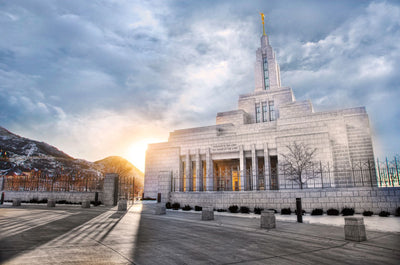
The Salt Lake Temple has been closed for an extended period of renovation, not because something went wrong, but because the Church made a deliberate decision to do the work properly. To strengthen the foundation. To prepare the structure for what's coming. Specifically, to reinforce it against the possibility of a significant earthquake in the future.
You don't close a building like the Salt Lake Temple lightly. It takes planning, sacrifice, and a long view. But the reason is clear: the foundation needs to be strong enough for whatever lies ahead. And to get there, you have to do the work thoroughly, not just cosmetically.
We are the same.
There are seasons in our lives when we need more than a quick touch-up. There are seasons when the Lord, in His wisdom and love, invites us to go deeper, to let Him strengthen the foundation, not just repaint the surface. Those seasons can feel inconvenient, even painful. But they are not punishments. They are important preparation steps.
Daily repentance and regular temple attendance are not separate habits. They are the same habit, expressed in two directions. One is turning inward to invite the Savior's cleansing work while the other is turning outward to receive His power and revelation. Together, they are the process. Together, they are how we become people whose walls don't just look clean, but are clean all the way through.
A Fresh Coat Every Day
I used to think of repentance as something reserved for serious sins. A dramatic moment. A hard conversation with a bishop. Something you hoped you'd never need too often.
I think differently now.
Repentance is primer. It's the daily step that makes everything else possible. It keeps the surface ready, it gives the new paint something to hold onto, and it prevents the small chips and scuffs of daily life from becoming the kind of damage that requires something much harder to fix.
President Nelson said it simply:
"Daily repentance is the pathway to purity, and purity brings power." (Russell M. Nelson, "We Can Do Better, and Be Better," April 2019 General Conference)
Repentance leads to purity and purity brings power. Not just forgiveness but power. The power to be who you were designed to be. The power that comes from a foundation properly strengthened, a surface properly prepared, a wall that is clean not just on the outside but all the way through.
That's what I saw at the temple — a wall that had been chipped and worn, made seamless again by someone who cared enough to do the work properly.
That's what the Savior offers all of us.
A fresh coat. A clean start. No trace of what came before.
The process works. Do it right. Don't skip the primer.



Leave a comment